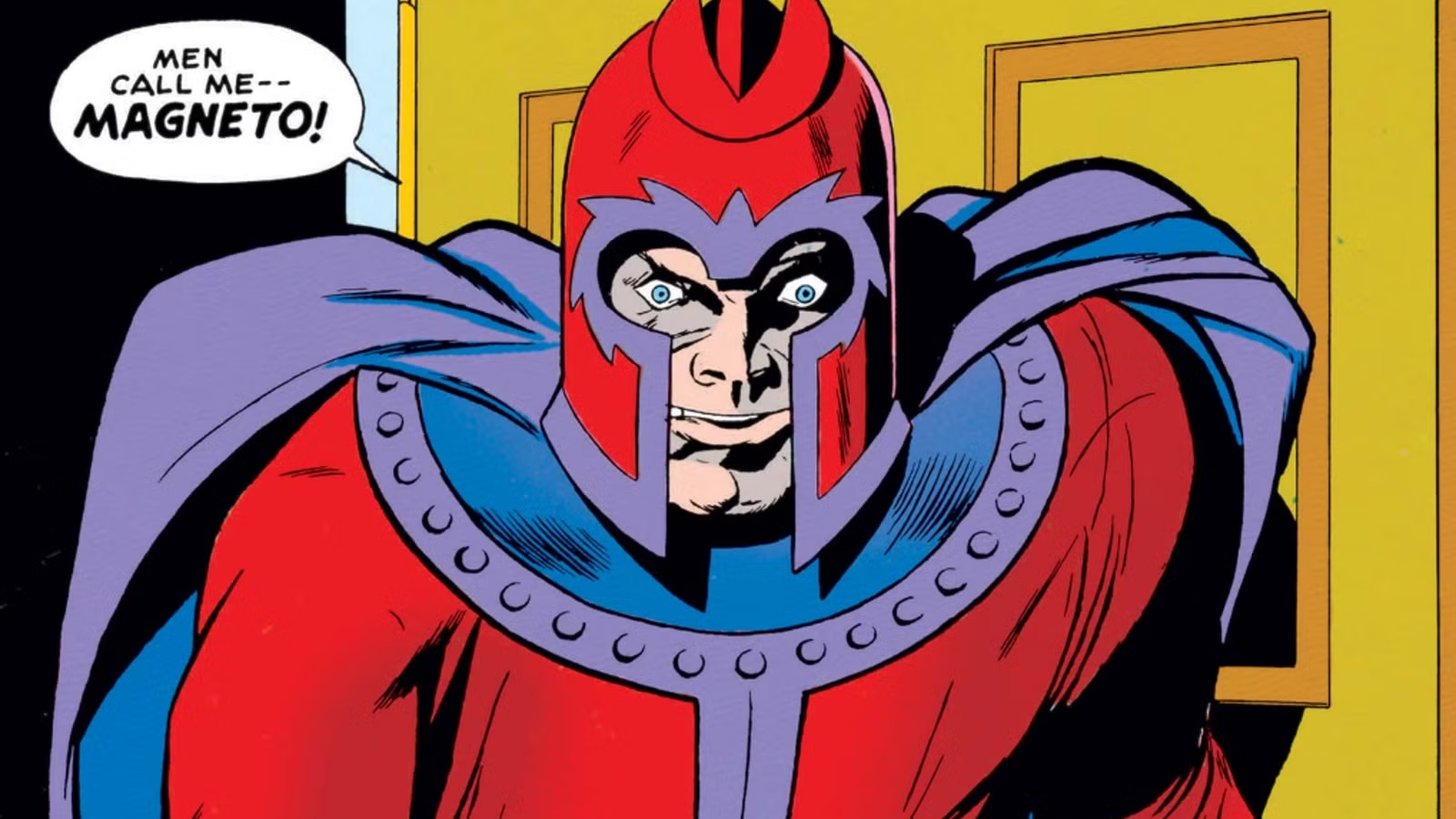
Dark Horse Comics’ Most Villainous is set to premiere this October. A series of hardcover collections paying tribute to some of Marvel‘s most iconic villains, the collection kicks off with the X-Men‘s most famous foe, Magneto. Created by Stan Lee and Jack Kirby in 1963, Magneto made his debut along with Professor Xavier and the original five X-Men in X-Men #1. Since then, he’s been one of Marvel’s most beloved characters, with multiple self-titled series under his name and endless T-shirts and bumper stickers claiming, “Magneto was right!”
Yet, long before “Magneto was right,” he was very, very wrong, and Most Villainous is set to focus on some of his most malevolent moments. Focusing on the 40 years between his creation in 1963 to his controversial revert to form in New X-Men in 2003, this book has plenty of material to choose from. Once a simple one-note Silver Age villain, Magneto’s character would ultimately be reimagined as a troubled revolutionary by writer Chris Claremont early in his legendary X-Men run.

In his first appearance, Magneto gleefully sank a submarine, marking him as a terrorist with sights set on world domination. Contrasted with Xavier’s dream of co-existence, Magneto’s vengeful rage at humanity became the then-teenage X-Men’s greatest threat, and he appeared regularly throughout their early days.
Though Magneto most often fought the X-Men during this era, he made regular appearances across the Marvel Universe. Imprisoned in the center of the earth after a fight with the Avengers, Magneto made his escape in the highly bizarre Defenders #15-16. In this story, Professor Xavier teamed with the Defenders to stop Alpha The Ultimate Mutant, a being bioengineered by the villain to help him gain revenge against the world. Realizing Magneto’s evil schemes, Alpha physically reverted the villain to infancy, effectively turning him into a helpless baby for years of continuity.

Regardless of his villainy, reverting Magneto to early childhood was a pretty sick move, and he would later repeatedly address the fallout. In Uncanny X-Men #112, he reappeared in adult form, forcing the X-Men to suffer through the infantilizing experience of involuntary dependency on his robot, Nanny. The X-Men didn’t have anything to do with the original transformation, but even at the best of times, Magneto’s grudges are rarely logical.
Still, this marked a time of change for the villain. As of Uncanny X-Men #150, Magneto’s past as a Holocaust survivor became canonical when he recoiled at almost killing the young, Jewish Kitty Pryde during a fight. Claremont almost single-handedly created this more nuanced Magneto from the mustache-twirling villain of yesteryear, with Xavier soon naming him headmaster of the Xavier Institute. There, he oversaw the young New Mutants, who spent most of their time rebelling against his authority. During this time, he found himself navigating a difficult position as the White King of the Hellfire Club, a group of wealthy, hedonistic mutants secretly pulling the strings of world leaders.
Magneto’s stint as a stand-in for Xavier at the school was perhaps destined to come to a messy end as the New Mutants left the Institute and he himself departed the Hellfire Club. For years, he would again be the moral counterpart of Xavier. During the 1990s, he ruthlessly ripped Wolverine’s Adamantium from his bones, started a borderline cult on his space station Asteroid M, caused the death of his own clone during “The Magneto War,” and served as the impetus for the world-threatening Onslaught. In the early aughts, writer Grant Morrison dropped the complex characterization of the morally ambiguous Magneto for a return to his over-the-top Silver Age shenanigans.

Most commonly today, Magneto is viewed as a complicated antihero, showing extreme ruthlessness counterbalanced by a surprising level of concern for his fellow mutants. Once upon a time, he was just a man in a red and purple helmet threatening to take over the world, but decades of different takes from different creative teams have added significant nuance to his story.
In addition to highlighting stories from creators like Chris Claremont and Grant Morrison, Marvel’s Most Villainous: Magneto features essays from comics historians John Lind and Chris Ryall. The 376-page hardcover collection is priced at $65, and has an Oct. 6 release date. It can be pre-ordered at your local comic shop or online through retailers like Amazon, Barnes & Noble, and Bookshop.org.

About the Author