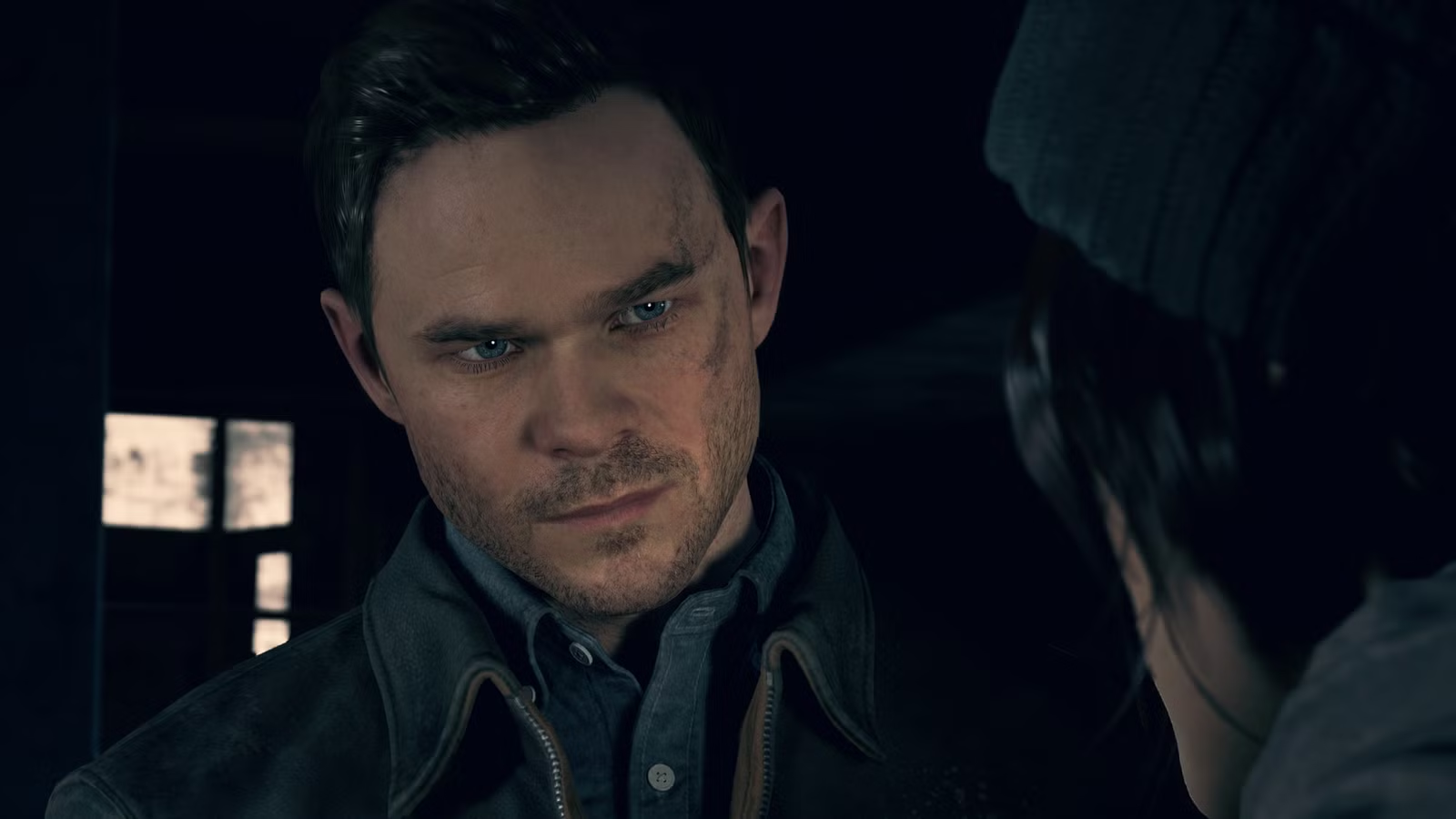
Remedy Entertainment has had one hell of a decade. 2019’s Control was popular enough to spawn an expanded universe. The 2023 action-horror game Alan Wake 2 picked up eight Game of the Year nominations, including one for the top prize. But the studio’s most innovative game of the past ten years was an underappreciated gem from the Obama years: Quantum Break.
Quantum Break, released ten years ago this month for Windows PC and Xbox One, was a boundary-breaking (heh) experiment in multimedia gaming. Part video game, part TV show, it mixed third-person shooting with an episodic narrative about time travel and evil corporations. The gimmick was, after every act break in the game, you’d briefly assume control of the game’s villain, and make a critical choice about the story. Your decision would then play out in the subsequent live-action episode.
It was a gambit, especially for the era; visual fidelity was sharp in 2016 but not exactly photorealistic, leading to some jarring transitions between gameplay and live-action. But the gimmick largely worked thanks to Quantum Break’s stacked cast. Shawn Ashmore (X-Men, The Rookie) portrayed protagonist Jack Joyce, estranged from his brother Will Joyce, played by Dominic Monaghan (Lost, Lord of the Rings). Aiden Gillen (at the height of his Game of Thrones fame) played Jack’s friend Paul Serene, who established Monarch Solutions, which, yes, is one of those evil corporations. The late Lance Reddick (The Wire, John Wick) turns in a masterfully cunning performance as Martin Hatch, Monarch’s CEO.
In one early choice, following a disaster at Monarch, Paul has to choose whether to use force or manipulation to cover it up. If you choose force, Monarch protesters are killed. But if you choose a manipulative approach, the protestors are let free — under legal condition that they can’t speak about events they witnessed. Later in the game, Paul has to choose to side with or against Martin; the consequences of that choice ultimately determine whether or not Paul ends up murdering another key Monarch employee in cold blood. Every choice features stakes this high, leading to a web of potential TV episodes so byzantine it makes one’s head spin. (For those curious: the Quantum Break wiki has an exhaustive rundown of every possible outcome.)
Of course, Quantum Break would’ve been lost to time if it wasn’t actually fun to play, but it was also a competent third-person shooter in its own right. Time manipulation serving an integral role in the story gave Remedy the leeway to implement some inventive abilities. One allowed you to create a temporary bubble of localized stopped-time, allowing you to shoot enemies and run away before the bullets even hit them. Your dash slowed down time, allowing you to escape tight situations. One move was basically a freakin’ time grenade, which is just as awesome as it sounds. What could’ve been yet another cover-based shooter turned into a frenetic ballet, as you blinked in and out of existence around the battlefield.

Clever weaponry aside, Quantum Break was far from perfect. In relation to some other Remedy Entertainment games, it was received fairly middlingly: the Xbox One version is currently sitting at a 77 on Metacritic. (Control and Alan Wake 2 are both in the 80s.) Reviews from the time praised the “gaming” aspects — gameplay, graphics, that sort of thing — and the unconventional structure. But critics weren’t convinced that the multimedia concept, while truly ground-breaking, coalesced as smoothly as it could’ve. Quantum Break, the thinking went, was proof positive that a hybrid video game/TV show could work, but was far from the platonic ideal of the form.
So why didn’t Remedy follow it up? After all, according to Microsoft, which published the game, Quantum Break “exceeded” sales expectations. (Exact sales figures aren’t publicly known.) But after 2016, Remedy and Microsoft moved on from what was then an exclusive publishing deal between the two companies; the rights to Quantum Break remain with Microsoft.
You could also speculate purely on practical lines as to why, even beyond a Quantum Break sequel, no other company has followed in Remedy’s footsteps. For one, Quantum Break was obviously an expensive production — just think of how many versions of each episode they had to produce — that happened during Xbox’s ill-advised “it’s not a gaming console but a media center” era. Plus, Remedy was a bit ahead of its time in terms of audience willingness to deal with large game files. (Quantum Break mandated a 75 GB “episode pack” years before 100+ GB games were the norm.) Whatever the case, Quantum Break was the first AAA game of its kind. It shouldn’t be the last.

About the Author