Earlier this month, a team of astronauts ventured around the moon in the first manned trip outside Earth’s orbit since 1972. Though they didn’t land on the moon, just the act of venturing beyond Earth’s atmosphere and into the unknown is mesmerizing. Amid all the horrible atrocities taking place on Earth, something so aspirational as going to space to push the boundaries of exploration is captivating. Every time astronauts venture outside the confines of the big blue marble to the moon, they learn a little bit more about that hunk of space rock, as well as about what humanity is capable of.
I too underwent a lunar journey this month. Except mine involved getting attacked by robots.
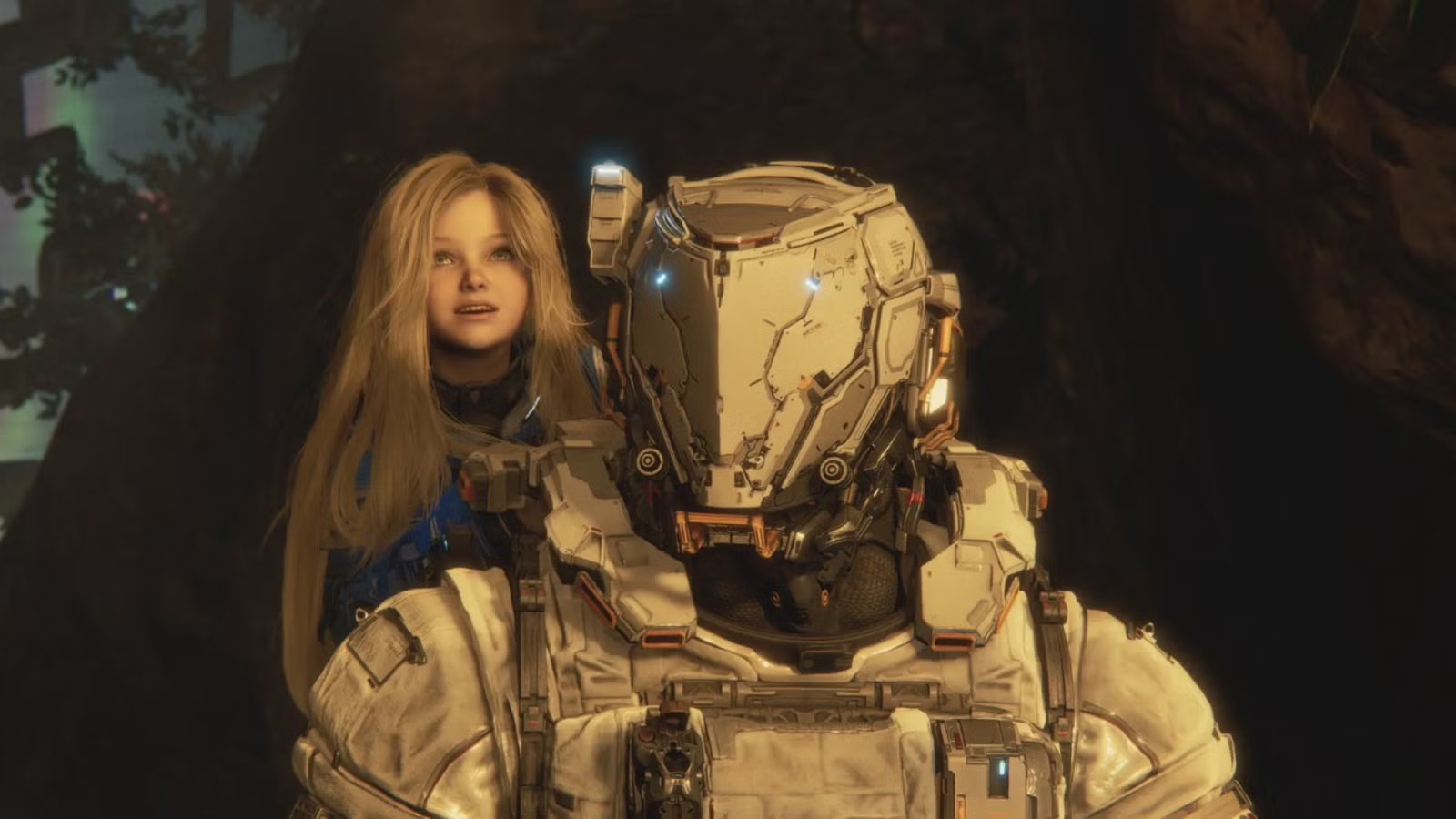
As astronaut Hugh in Capcom’s Pragmata, I ventured to a version of the moon that already has an established human presence and is home to a research facility run by the Delphi Corporation. I guarantee my space mission experience is wildly different from the astronauts on the Artemis 2 mission: instead of spitting into a tube or being woken up by “Pink Pony Club,” I was hounded by killer 3D-printed robots ordered around by a rogue AI. Hopefully no future real-life astronauts traveling to the moon encounter the same fate.
Pragmata has been a long time coming, and for years all prospective players got to see of it were trailers with cutesy delay messages. Capcom announced it during the June 2020 PlayStation 5 reveal stream, and here we are potentially on the precipice of another generation of hardware. But Pragmata shows that innovation can’t be rushed. It happens one small step at a time before bounding forward with that giant leap.

Joining Hugh is Diana, a childlike android who’s vital to both Pragmata’s gameplay and its story. Their relationship, strengthened as they investigate the base and why the bots have gone rogue, forms the emotional backbone of the game. But the real core of Pragmata is its inventive gameplay systems; its defining feature is the way it combines standard third-person shooting with a hacking minigame. While these two elements may seem trite on their own, together, in the flow and intensity of combat, they make Pragmata feel like nothing I’ve ever played before.
All enemies in Pragmata are robots, meaning they’re all susceptible to being hacked — and you’ll have to hack them to deal any damage. Otherwise, Hugh’s bullets do a fraction of the damage you’d expect. Aiming at a robot will allow Diana, perched on Hugh’s back, to hack it by moving a cursor through a series of nodes on a grid toward a green endpoint, which opens up the enemies’ weak points. Once exposed, Hugh can blast away.

Hacking is surprisingly intuitive. At first, I thought it might take some getting used to as the controller’s face buttons are used to navigate the grid (not the D-pad or thumbsticks) and you can’t move the camera simultaneously while hacking. But after a few hacks, the controls start to feel natural. I become an experienced juggler, simultaneously moving Hugh around, aiming at a robot, pressing the right bumper to dodge, and navigating the hacking grid. The system has the potential to feel overwhelming, but becomes second nature; by the end of the game, I’d keep my focus on an enemy and its attacks while navigating the grid in my periphery.
And keeping an eye on your enemies at all times is key as the hacking is done in real-time. Pragmata doesn’t pause; time doesn’t slow down. Hugh’s in danger every step of the way.
The real-time nature adds an adrenaline-pumping stress to Pragmata’s combat. I’ve become so used to cover-based third-person shooters where I can drop down behind some rubble or throw my back at a pillar for some breathing room. No such reprieve exists in Pragmata. Quite the contrary — several robots are larger than the beefy Hugh and plenty of encounters take place in small rooms or walled-off hallways, making it so Hugh and Diana must do a tricky dance with their enemies, dashing around attacks as Diana works to open up an enemy.

The hacking evolves greatly over the course of Pragmata. Blue nodes on the grid can increase the hack’s damage, and Hugh and Diana acquire various yellow upgrade nodes that can be added to the grid and affect enemies in different ways when passed through during a successful hack. One confuses robots into attacking their allies. Another freezes them in place. I often rely on the multi-hack node, which makes a successful hack transfer to nearby enemies, making large group encounters much more manageable; remember, Hugh’s guns ain’t worth shit unless an enemy is hacked and its weak points exposed.
There’s all manner of nodes to try out, as well as guns. Hugh starts with his trusty pistol, which replenishes ammo quickly over time. Other guns have limited bullets, and you’ll constantly have to swap them out for new ones throughout a level. The shotgun-like shockwave was an early favorite as well as the grenade launcher that could knock robots to the floor, opening them up for hacks without fear of being attacked.
And that’s where Pragmata really shines — everything in its combat comes back to the hacking. A subset of guns will make hacks easier, like stasis nets that hold enemies in place or sticky bombs that delete rows from the hacking grid. Once enemies are hacked, that’s your cue to switch to high-damage guns to take advantage of those weak points.

There are so many options available in Pragmata that its builds almost feel roguelike in nature. My favorite loadout focuses on building up a “heat” gauge in robots. Once a robot’s heat bar is maxed out, they’ll fall to their knees and open up for a critical attack, dealing bonkers damage. During some encounters, I’d focus less on shooting an enemy once open and more on completing a series of successful hacks, knowing that one critical attack was worth any number of normal shots. Different mods can enhance a build too, like one that increases hack damage but lessens weapon damage, and vice versa.
Though I was consistently switching up tactics and experimenting with different ways to approach combat throughout my 12 hours with the game, I still feel like there are strategies I’ve yet to discover. That’s the beauty of Pragmata; it combines two simple mechanics — a minigame and third-person shooting — to create something truly unique, something that begs to be tinkered with.

Other areas of Pragmata aren’t quite as innovative, and border on feeling outdated. Its narrative revolves around a corporation experimenting with artificial intelligence on the moon, but Pragmata isn’t saying anything new about the technology that something like The Terminator didn’t already articulate in 1984. There are some scattered emails about the heavy presence of corporate surveillance and how some workers are worried AI might replace their jobs. Ideas that may have reflected a frightening potential in 2020, when Pragmata was announced, are our reality in 2026. Jobs are already being lost to AI, including those in the games journalism industry.
Similarly, Pragmata is very focused on 3D printing in a way that would have felt novel years ago, but mundane today. Everything is printed by a special material found on the moon, from Hugh’s guns to the bots he battles. It’s introduced early on in a way clearly meant to make the player “ooooh” with intrigue, but 3D printing has become so commonplace that Pragmata treating it as remarkable feels uninspired.
Because the levels are 3D-printed constructions, however, Pragmata has leeway to feature a variety of locales to wander through. Delphi is experimenting with recreating parts of cities on the lunar base, starting with New York City. Navigating a facsimile of Times Square, and a forest level later on, helps free Pragmata from having to be a series of those white, drab moon base corridors that typically define lunar fiction.

Hugh and Diana’s relationship doesn’t tread new territory — we’ve seen plenty of Dad Games in recent years, like the God of War reboot and The Last of Us — but it is refreshing. After saying he doesn’t want to be a babysitter early on, Hugh pulls a quick 180 and embraces being something of a father figure to Diana. He’s encouraging, thoughtful, caring, and a damn-good dad, and together he and Diana make a fine team.
Hugh can bring gifts back to Diana called REM, Read Earth Memories. These are 3D recreations of everyday items on Earth, which Diana is delighted by. She loves hearing about Earth from Hugh, with basketballs and beach chairs helping her get an idea of what a normal childhood would have been like had she been human and not an android. Sometimes after being given a REM, Diana will offer Hugh a gift of her own: a crayon drawing of the two of them. You can also play hide and seek with her. Adorable.

Though some elements are more rote than others, like an unmemorable story centered around a killer AI, Pragmata’s hacking-infused gameplay is unlike anything I’ve played before, and makes the entire adventure worth checking out. Innovation like that isn’t achieved unless boundary-pushers return to a genre that’s been explored countless times for another expedition. Like how astronauts first went to the moon in the 1960s and have been chipping away at more lunar knowledge since, the third-person shooter has been solidified for some time. Some people have wondered what the point of more space exploration is. We’ve already been to the moon — why go back? We’ve already perfected the third-person shooter — why mix up a good thing?
Because there’s still so much to learn, and so much opportunity to innovate. The astronauts aboard the Integrity spacecraft are paving the way for more space exploration in the near future, and who knows what other discoveries are yet to be made. Capcom’s Pragmata is innovating on a genre after a long, long development cycle and coming back with something unique to show for that work. We won’t know what else lies beyond traditional genre conventions — or the moon — if we’re not willing to venture past already known horizons time and time again.
Pragmata will be released April 17 on Nintendo Switch 2, PlayStation 5, Windows PC, and Xbox Series X. The game was reviewed on PS5 using a prerelease download code provided by Capcom. You can find additional information about Polygon’s ethics policy here.
About the Author