Bear with me. Trying to explain Titanium Court feels a bit like teaching Advanced French to a class of third-grade Massholes. The unclassifiable indie, and the winner of the Seumas McNally Grand Prize at this year’s Independent Game Festival, is so gleefully wrapped up in criss-crossing systems that you’ll need to become fluent in its own language to fully get a handle on it. That’s not an onboarding failure; it’s the whole point of developer AP Thomson’s absurdist delight.
Let’s take a step back: Video games are fucking complicated. Those of us who have been playing them for decades often take for granted how even the medium’s most basic concepts can sound like gibberish to the average person. I’m not even talking about the real goofy jargon like Metroidvania or Soulslike; stop someone on the street and ask them what a strategy game is. Challenge your Candy Crush-obsessed mom to define the word platformer. Make your grandfather figure out what RPG stands for and watch him vaporize instantly. The impenetrable gibberish extends beyond the words we use to classify games; the design language of any given game, born from decades of iteration that goes countless layers deep, can be just as difficult to parse for newcomers. Hell, I have been writing about video games for two decades, and I would piss my pants if you asked me to hold my own in a MOBA.
If you fancy yourself gaming royalty, Titanium Court will do everything in its power to bring you down to the bottom of the manor economy with the rest of the peasants. It’s a riotously funny kingdom management game that has as much fun as it can playing the role of a jester while gradually revealing how its ingenious genre-fusing play works. And more impressive still is how Thomson finds space on that stage to turn a self-aware video game deconstruction into a bit of wartime satire. It might seem like it’s just screwing with you at first, testing your game design literacy, but play along with it and you’ll discover an inventive work of comedy that’s a joy to outwit.
OK, how do I explain this? Titanium Court is a tower defense match-three puzzle strategy roguelite placed inside a lo-fi Apple II graphic adventure. That’s a mouthful; let’s try something snappier, more approachable. Titanium Court is a medieval isekai. Shorter, but not descriptive enough. Titanium Court is what it would look like if you put Infinite Jest’s Eschaton into A Midsummer Night’s Dream. Christ, this is going to take a second.
Let’s maybe just start with the story. We all understand stories, right? You play the part of a regular Joe who finds themself magically whisked away to a fantasy realm after getting lost in the woods. When the faeries from a nearby kingdom find you, they crown you as their queen in exchange for your help fighting a war. You, of course, really only care about finding your lost keys so you can escape the court and return home. The only way to accomplish that is by playing ball and becoming a master strategist who can fend off enemy troops and fire-breathing dragons long enough to find four keys and exit through the front gate.
That adequately describes roughly 1% of Titanium Court, I’d wager. A ye olde tale that sounds simple enough on paper becomes a springboard for plenty of hilarious fish-out-of-water comedy. The kingdom operates on convoluted rules and customs that sound like they’re being made up on the fly — an empire run like a game of Calvinball. War, for instance, is scored like a baseball game via a scoreboard… except that bringing a “football” (that’s definitely an egg) to the “end zone” nets you extra points. The cultural misunderstandings go both ways. Occasionally during a battle, you’ll stumble upon a road sign from the real world. Your companions will read that as an ominous prophecy rather than literal instructions for drivers. It’s no use explaining it to them either, because trying to prove the existence of cars is a conversational dead end. Faeries are known for being mischievous little tricksters, and so too is Thomson in constructing a fantasy farce that’s always goofing around with you.

It’s all very much in the spirit of classic PC adventure games, which Titanium Court is deeply indebted to. You can see it in the minimalist art that looks like it was programmed on an ancient PC and the breaks between battles, where you direct your pea-sized splotch of a hero around the court’s halls solely through on-screen arrow buttons. It calls classic fantasy games like Sherwood Forest to mind. That era of adventure games was all about throwing players into an unknown world and challenging them to figure it out for themselves. How do I navigate these screens without a map? What am I supposed to do with this piece of flint? These were language tests as much as they were adventure games; the goal was to conquer a game by becoming fluent in its obtuse design.
Titanium Court brings that same energy to the table, lampooning video game logic at every unpredictable turn. That’s where the wartime strategy comes into play. Describing it adequately is a daunting task; the genre mash-up makes for the most exceedingly clever play I’ve found in a game so far this year, but it’s going to sound like I’m speaking a different language when I try to lay it out. Take a deep breath with me here.
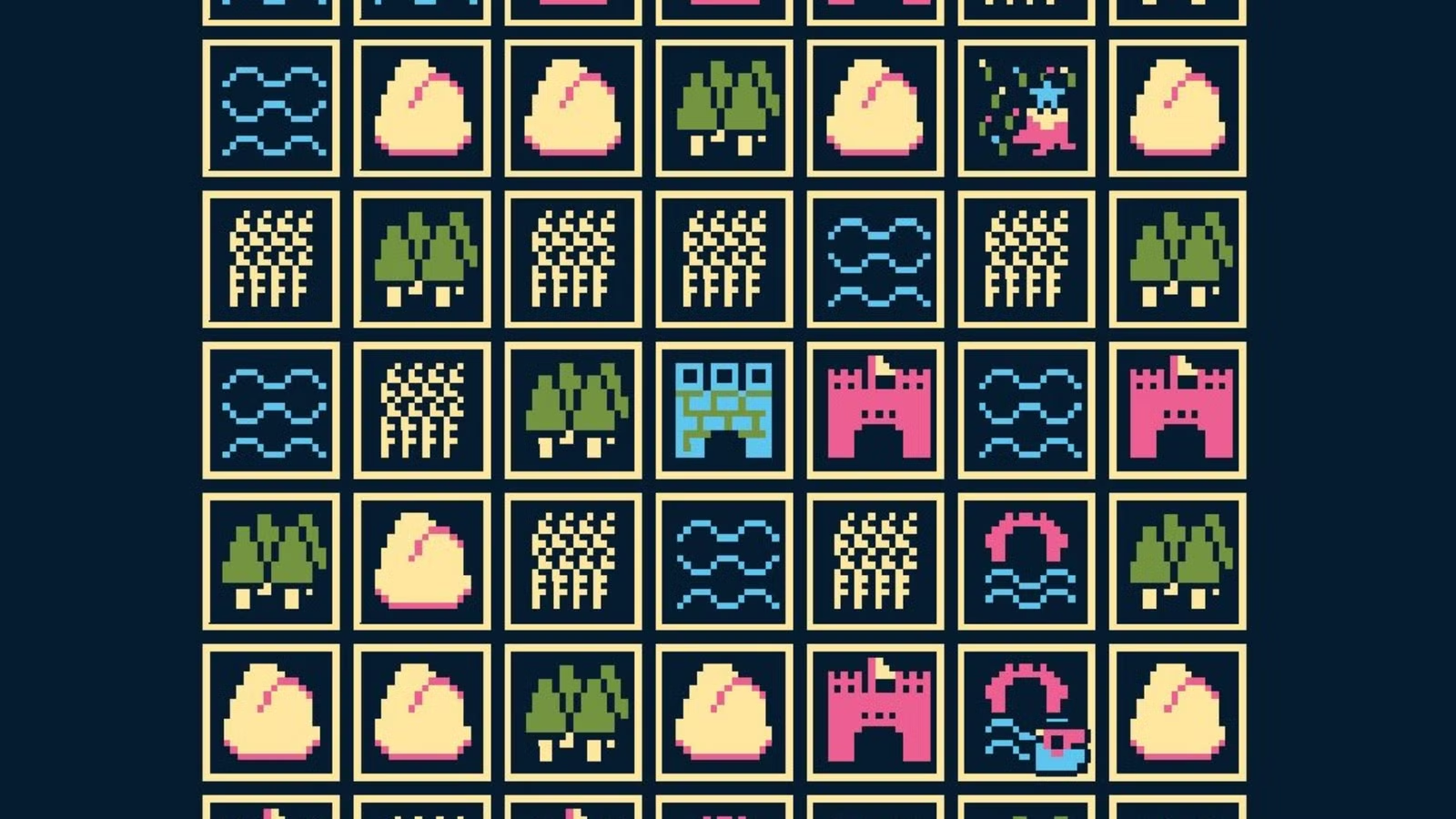
To successfully win a day’s skirmish, you need to survive a series of battles. Each one takes place on a grid filled with various terrain tiles: water, fields, rocks, enemy strongholds, and your own base that needs to be protected from invaders. The setup phase has you rearranging the battlefield via the same match-three puzzle rules that power, say, Candy Crush. Match three or more strongholds together and they’ll disappear off the board. This doubles as a resource gathering phase. Match some grain tiles and you’ll get food that you’ll need to summon troops. The same goes for forests (wood), rivers (water), etc. Your castle, and any defensive structures you may pick up during a run, can be moved freely to put them in an advantageous position. Putting some rocks or rivers between your court and enemy bases is a smart defensive move, for instance.

Once you run out of moves, the board locks in place and it’s on to phase two. You use your resources to summon workers who can gather resources from nearby tiles and soldiers who will attack all bases and incoming enemies. Each has a function and resource cost, and you can add more units to your hand by buying them from shops if any end up in your grid at the end of the puzzle phase. Once you’ve selected the order your troops will deploy in and unfreeze time, the battle auto-plays like a tower defense game. Plan everything well enough that the court doesn’t lose all of its health and you’ll move on to the next battle, working your way up to a final boss fight. Win and you’ll get to explore the court in the evening, uncovering plenty of new mysteries and banking some of your resources in a cellar.
An exquisite dynamic pops out of the interplay between those various genres. The puzzle phase is as satisfying as any match-three game, but you have to resist the temptation to set off big combos that make your brain tingle. A massive chain reaction could match away your cover by accident or cause a ton of enemy strongholds to fall into your puzzle well. You always need to be deliberate with your matches and think ahead to how it will set you up for the strategy phase. There’s a deceptive level of depth to it all, which fills the game with tactical eureka moments from start to finish.

Once again, all of this barely describes what’s going on in Titanium Court, where the fun comes from watching Thomson infuse everything with escalating silliness. You’ll need to deal with catapults and boats, keep those fragile “footballs” safe during battles, pay your toll fees to a trio of angry goats, learn defensive spells from a karate master, read billboards advertising cheap tacos, occasionally stop to hear Thomson perform a song about salmon instead of fighting a boss at all, and so on. Bosses can be defeated in different ways that cheekily reference Civilization’s win conditions. (Yes, you can pull off an economic victory over a dragon, duh.) You can also try going into battle with a different class that has its own distinct play strategy. The default queen class can summon soldiers who get gold from destroying strongholds; a rebellious youth class, on the other hand, fights by setting the land ablaze with a lighter because they just want to see the world burn, man.
Are you still with me? I hope so, because what sounds confusing on paper is a playful joy with so many silly delights to discover.
There is no universal quantitative metric for taking the piss.
Titanium Court throws a lot at you. Even when it’s just teaching you how to play, it’s doing so through a laugh-a-second clown routine where every new system it introduces doubles as a fresh bit. Have you ever seen one of those viral videos of a Turkish ice cream vendor trolling a customer by constantly pulling the treat out of their hand through quick sleight of hand tricks? That’s how Thomson approaches game design. He keeps putting the cone within your reach and yanking it back in some way you’re not expecting. To grasp the systems well enough to complete a run of battles is to conquer the dastardly ice cream man.
It works on two levels. First, there’s that metatextual read of Titanium Court as a joke about game design literacy. It wants you to feel a little out of your depth as you try to get a handle on its stack of compounding gameplay twists. (Like I said: Video games are fucking complicated.) But zooming out, it works as a jab at the mighty stupidity of warfare too. The fantasy conflict is depicted as a childish game where the rules of engagement are ever-changing and filled with exploitable loopholes. It’s a home run derby where the two sides seem more concerned with running up the scoreboard than achieving a tangible victory. When you lose a battle, falling to some chaotic chain of events you hadn’t planned for, the continue button voices your resignation for you with one deadpan word: “Okay.” What more can you say? There’s a good reason that your goal isn’t really to win the war, but rather to get the hell out of there as soon as you can.

If you’re still feeling a little lost as to what’s going on here: good. I don’t really know what I’m talking about either. The remarkably funny Titanium Court is out to lampoon things that are hard to make sense of, be it complex video games, meaningless wars, or baseball. (Especially baseball.) It shreds their rule books, scrambles the scraps, and leaves you to hunt for understanding in the nonsense. Or maybe it’s just messing with you.
“There is no universal quantitative metric for taking the piss,” a faerie tells me when I ask just how much everyone in the kingdom is screwing around. Okay.
Titanium Court will be released April 23 on Windows PC. The game was reviewed on Windows PC using a prerelease download code provided by Fellow Traveller. You can find additional information about Polygon’s ethics policy here.
About the Author