When Malcolm in the Middle debuted 26 years ago, it changed the face of TV sitcoms forever. Since the creation of the genre in the 1950s, the art form had almost universally used the multi-camera format, where a handful of cameras follow actors performing the majority of the show on standing sets, often with a studio audience. Then at the turn of the century, Malcolm in the Middle, along with shows like Titus and the original British version of The Office, broke the mold by exploring new ways to bring comedy to TV that felt more like a movie and less like a stage play.
Malcolm in the Middle was particularly ambitious. Not only did the series employ this more film-like approach, it was also incredibly fast-paced and had a main character regularly breaking the fourth wall with extensive monologues. That last one would be a lot for any lead star to handle, much less a child actor.
“One thing everyone said, including myself, was, ‘We’ll probably never find this kid,'” series creator Linwood Boomer tells Polygon. “Malcolm was kind of an impossible role to ask a 12-year-old to play.”
Boomer did find his Malcolm in child star Frankie Muniz and proceeded to make a show so beloved that a quarter-century later, Boomer, Muniz and nearly all of the original cast reunited for the four-episode revival Malcolm in the Middle: Life’s Still Unfair.
The revival is also why we’re running this previously-unreleased interview with Boomer conducted in 2023 for an oral history that never came to fruition. The revival was in its infancy then, which is why it isn’t addressed here, but Boomer does talk about the origins of the autobiographical series as well as early casting decisions — like how Jennifer Coolidge was almost cast in the series in Jane Kaczmarek’s role, and how Bryan Cranston’s personality shaped his character.

Polygon: Where did the idea for Malcolm in the Middle come from?
Linwood Boomer: All through my writing career, during every lunch, I would tell stories about when I grew up. My writer friends were telling me, “This is a TV show,” but I was like, “It’s actually depressing.” This is a story about a kid who has absolutely no resources, no friends, his family can’t and won’t help him. It’s not funny.
But when it came time for me to write a sample script again, I was like, “Everyone’s telling me I should write this.” I started three or four times to write some version of my childhood, and it didn’t work. It was just sad to me. I couldn’t make it funny. Then I got the idea to steal the mechanic they used on The George Burns Show and It’s Garry Shandling’s Show, which was to talk to the audience. That gave a way for the kid to “talk back” in a way that was believable. That, to me, made me feel like he’s got one friend. That emotionally unlocked it for me. Then I wrote it very quickly.
Frankie was almost supernaturally gifted.
How hard was it casting a character that was basically playing you?
One thing everyone said, including myself, was, “We’ll probably never find this kid.” Malcolm was kind of an impossible role to ask a 12-year-old to play — to be this good of an actor and this naturally funny and handle all the technical demands of the script. Yet, we found Frankie Muniz on the second day of casting. He was on a tape from New York and it was undeniable. Frankie was almost supernaturally gifted.

What was it like working with the other kids?
Justin Berfield just understood Reese. The words he was given were dumb, and he just had to say them as if they were smart. He knew what the funny was with that character.
Erik Per Sullivan was perfect for Dewey. It’s very tough with a kid that young to have them act. They can kind of pantomime and copy lines, but he actually could act. He was so simple and natural.
For Francis, Christopher Masterson brought the character a sense of idealism. It wasn’t just about wanting to destroy things, it was that Francis hated bad authority and had terrible judgment about what to do about it. Francis really did care about other people, and I loved having him be a fuck-up that you’re rooting for.
A nine-year-old punching a security guard in the nuts is objectively funny. But a 16-year-old guy punching someone in the nuts is assault.
What about Jane Kaczmarek?
Jane Kaczmarek didn’t audition until about two months into the process. Todd Holland, our director, was like, “She’s got to do it,” but I was still looking at other people, like Merilu Henner, Pam Dauber, and Jennifer Coolidge. We had tons of really good people, and we took them all to the network, and Jane was just better. I don’t think she got all the way out the door when Doug Herzog said, “It’s got to be her.” All of them were great, but Jane just clicked extra with the part. She owned it. It’s not something you can quantify.
Jane really understood that character. It was a mom with four brutally tough kids. No money, no help, there’s almost never even a babysitter. It’s tough to have that level of annoyance and anger all the time and yet still be kind of charming. Her chemistry with Bryan was also instant. They were also the only adults, so they clicked quickly. Their real personalities were as compatible as their characters’ personalities.

Can you talk about casting Bryan Cranston?
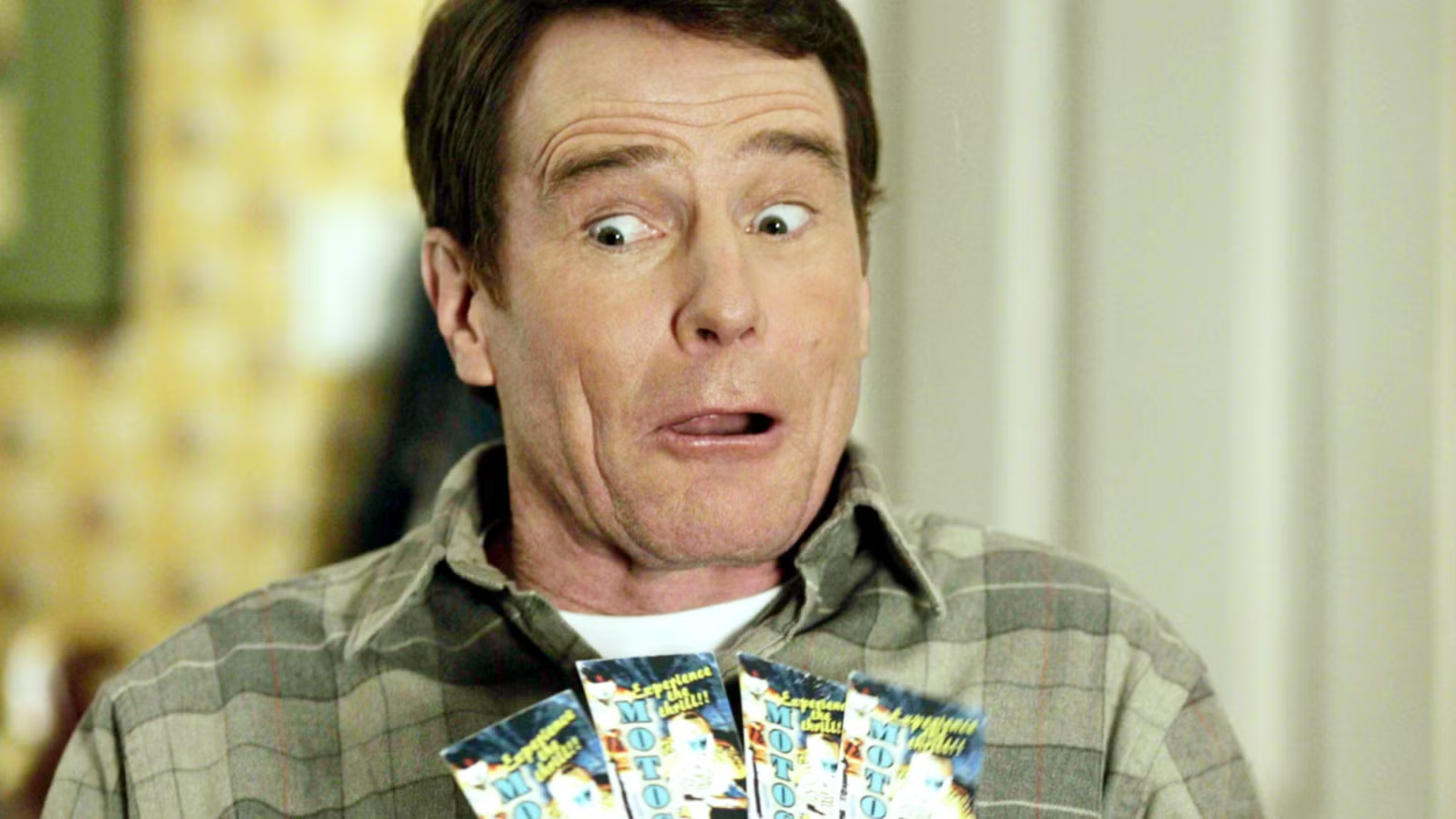
Whereas Frankie fit everyone’s preconceived notions, Bryan Cranston was the best example of someone not fitting those preconceived notions and showing you something totally different.
It was funny. I’d written him to be this very remote, disconnected kind of guy, which isn’t that funny. But with Bryan, while he was listening to the other characters talking, he looked like he was building a rocketship in his head and that’s why he wasn’t listening very well. He just had so much going on, and he kept getting surprised that somebody else was talking to him.
Bryan became willing to do anything, so Hal became willing to do anything. That unlocked everything for me and the writers. Between the writers, it was like, “What do you think he won’t do?” and I was like, “You want to see if we can cover him in thousands of live bees?” And Bryan was just like, “Sure. Go ahead. Sounds fun.”
That’s what all the outrageous stuff was based on — Bryan’s personality.
Also, Hal’s introduction in the pilot, where Lois is shaving his back, that was real. About every six weeks, my dad would stand on newspapers in the kitchen and my mom would run the buzzers up. And, my mom actually did think it was a waste to throw it away, so she put it in the backyard, so the birds could make nests out of it. I remember thinking as a kid, “People are going to know that nest is my dad’s body hair!”
As the series continued on, did you have to account for their changing ages at all?
With Malcolm and Reese, right around the third or fourth year, we had to tone down the hijinks. Twelve-year-olds vandalizing things is like, “Aw jeez, those kids are crazy.” But 16-year-olds destroying stuff is like, “What the fuck is wrong with them?” It doesn’t have quite the same tang to it.
A nine-year-old punching a security guard in the nuts is objectively funny. But a 16-year-old guy punching someone in the nuts is assault.
You left the series before the final season, season 7. Do you mind sharing why?
I wasn’t 25 years old anymore, and it was a 90-100 hours a week job. The way I put it was, “This is taking 10 years off my life and if I retire now, I’ve got a shot at getting those 10 years back.”
And I think I have. I’ve had a very nice life — a lot of freedom and a lot of time. I founded a charity called Healing California, which provides free dental and vision care for homeless veterans and people in need all over California. I made a lot of dough off of Malcolm, and I’d always given a decent amount of money to charity, but I get to do more now.

Why did the show end?
The ratings were not high enough anymore to justify another year. Usually, that kind of thing is an economic decision made by the people who are paying for it.
You did return to direct the finale. Can we talk about that?
There was no way I was going to let anyone else direct or produce the last episode.
For the finale, we really wanted to make sure we weren’t doing the thing where, “The kid who had a lot of money, now he’s poor” and, “The kid who was really smart is a real failure,” which you see a lot of in finales and in reunion shows. I thought, “Let’s do the opposite.”
We’d started with Malcolm and Lois’ relationship — that was always the largest thing in the show. Because it always seemed that the parents were a little bit preoccupied, Malcolm always felt that he had no resources in that family. We wanted to address that — that all the awful things that have happened to him were for a purpose. It wasn’t that Lois was making horrible things happen to Malcolm, but she was going to make good use out of it in a very Lois way — “You’ll be the first president who ever gives a damn about people like us.”

Do you have a memory from the finale you’d like to share?
We’d have these long monologue rant scenes and Frankie would just do them. It was astonishing. He did it in the pilot and for seven years of filming, and he did it in the finale too.
I remember when we were doing the last episode, we’re in the backyard. Frankie is covered from head to toe in muck, and he’s doing this screaming monologue. Everyone in the crew — much of the same people who were there in the beginning — gathers around and they know this is the last time, and it was another moment, just like in the pilot, where they’re all stunned by how talented he is. I burst into tears when I saw that.
About the Author