Kagurabachi fans, rejoice. An official anime for one of the most celebrated modern Shonen Jump works is set to debut next year, and so far it has wrangled a stacked creative team. Helming the highly anticipated project is legendary animator Tetsuya Takeuchi, whose credits span years across some of the medium’s biggest productions, including Devilman: Crybaby, Lycoris Recoil, Heavenly Delusion, Star Blazers 2199, Bleach, and Naruto, among many others.
Takeuchi is arguably one of the sharpest minds working in action anime today. He cut his teeth on industry staples, rising through the ranks during the height of the “boot-camp” era of the late ’90s and early 2000s, when long-running TV anime demanded expert timing, spacing, and impact over polish.
Like many within the Studio Pierrot action pipeline, Takeuchi learned the fundamentals that defined that era: selling speed with limited frames and choreographing fights with readable precision. A core element of that style, especially in Naruto, was injecting personality into motion.
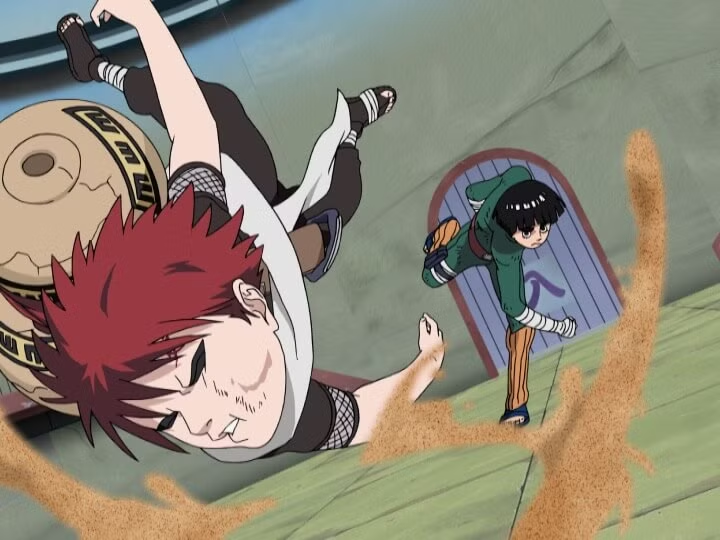
This is why so many stand-offs in Naruto are still revered today. Case in point is Rock Lee versus Gaara — a fight that, despite the sakuga-heavy highs of Jujutsu Kaisen and Chainsaw Man, is still regarded as one of anime’s most cinematic action sequences.
Don’t take my word for it. Even Takeru Hokazono, the creator of Kagurabachi, pointed to that very fight as a benchmark during a recent Shonen Jump press event:
“You know, the Rock Lee vs Gaara fight in Naruto? The manga version is great, of course, but isn’t the anime version incredibly cool? Well, the very person who brought that scene to life is our director!”
The Rock Lee versus Gaara fight in Naruto remains legendary, particularly for how it deliberately builds upon itself like a slow, tightening coil. Lee starts out outmatched, boxed in by Gaara’s automatic defense, and then, piece by piece, he breaks the rules of the fight. Every movement is clear, every hit escalates, and when Lee finally breaks through, it feels completely earned. But it’s the turn that cements everything: even after pushing himself well past his limits, Lee still loses. It twists a triumph of effort into something far more brutal and unforgettable, and the animation quality is staggering to boot.
While Hokazono isn’t wrong, he’s not entirely precise about Takeuchi’s involvement in this scene. He served as a key animator on seven episodes of Naruto, contributing alongside a broader team on sequences like the Rock Lee versus Gaara fight, according to the Artist Unknown community animation blog. So he wasn’t exactly the sole animator on that scene, but still definitely helped design it.
That’s not to say that Kagurabachi isn’t in good hands — far from it. Distilling the potential of Takeuchi as a director down to a single Naruto fight undersells what he brings to the table. The animator has a clear stylistic identity and approach that fits exactly the kind of show Kagurabachi needs to be.
For instance, Takeuchi doesn’t use super flashy effects or speed lines to sell motion. Instead, his work emphasizes weight-first animation, the kind that lets you feel every movement, from bodies snapping and recovering after impact to strikes that displace air and dust in their wake. It’s a tactile approach that could give Kagurabachi’s swordplay a heavy and dangerous edge.
That pairs naturally with Takeuchi’s instinct for motion carrying emotion. The animator is well-versed in controlled slow-motion — which should add to the Quentin Tarantino vibes of Kagurabachi — alongside expressive micro-movements that embed character into action. A slight hesitation before a strike, a twitch of the eye, a stagger after impact: these are all subtle details that leave a lasting impression.
There’s no doubt that Takeuchi has a difficult task ahead of him, and a massive fan base to appease. But if his years in the industry and animation instincts are anything to go by, Kagurabachi fans are in for something special when it arrives next year.
About the Author