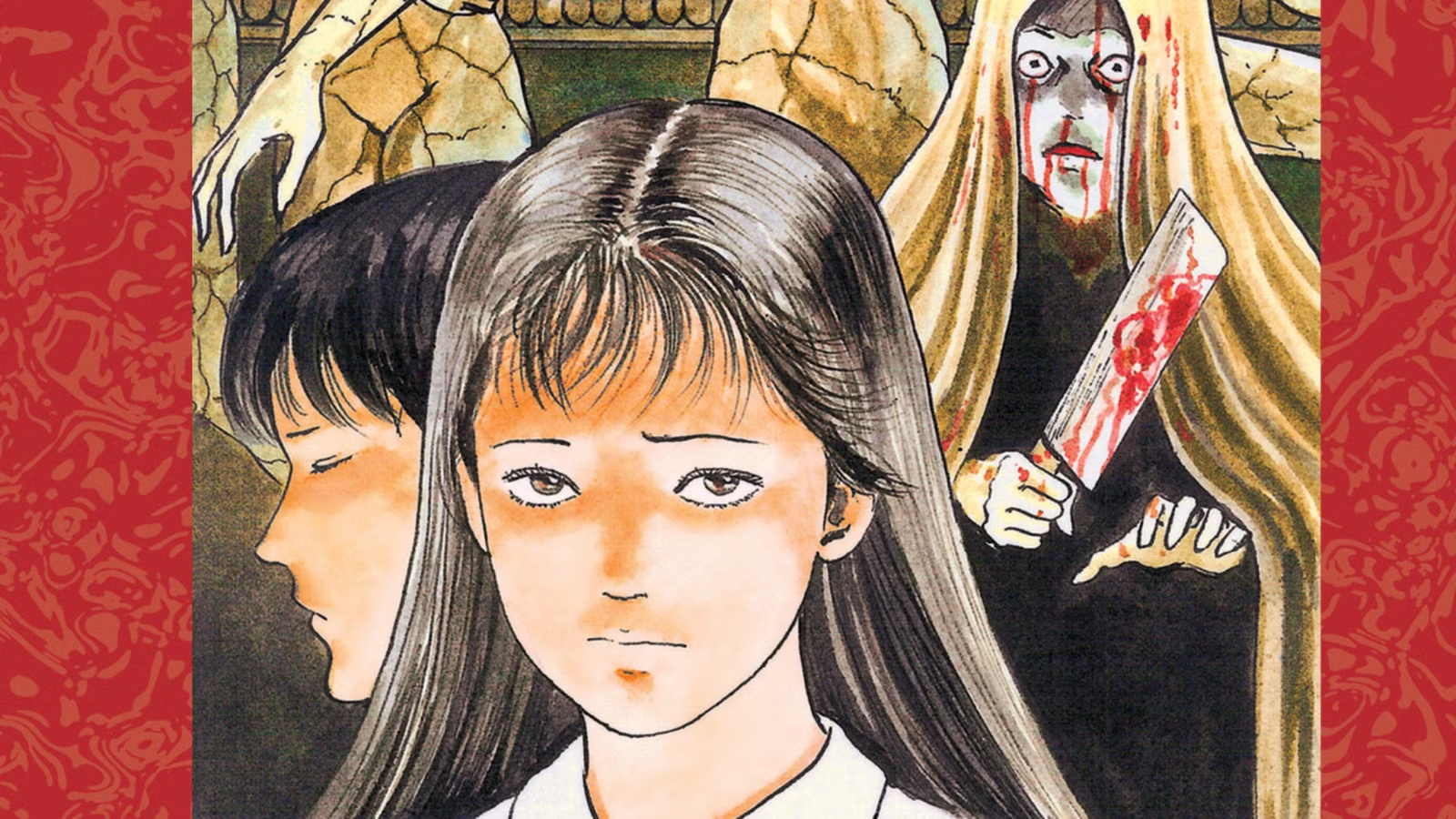
Scarecrows, headless statues, a cozy town filled with maps, red strings, a circus — Junji Ito’s knack for making the mundane feel cosmically unsettling knows no bounds. Statues, which debuted in March 2026 and compiles several new and old stories into an English language release, is yet another descent into the macabre mind of the medium’s most storied creator, and redeems the missteps of the underwhelming 2024 Uzumaki anime miniseries. Woof, that happened.
Statues is Ito’s name-brand weirdness at its finest. The 10-chapter compilation of strange tales offers insights into fascinating questions on human sociology, psychology, and the fragility of perception.

One of my personal favorites is “Dying Young.” Originally released in the 2000s, the story finds several high school girls gradually becoming more and more beautiful… only to eventually die. It treats this state of increasing beauty like a disease, and has left me wondering, on a deeper and more human level, what that would look like in the real world and how it would affect our daily relationships.
Some of my favorite tales by Ito come from his compilations, with Fragments of Horror arguably being one of his best. These shorter stories stand out for their more intimate focus on people reacting to something otherworldly and impossible, rather than the universe itself acting as the main villain, as seen in Uzumaki and Gyo. Ito knows just how to make the story land at the end, even when nothing quite makes sense along the way.
That’s where Statues shines brightest — or, more accurately, unnerves at its darkest. “Maptown” is a perfect example. It’s a more grounded narrative that follows a pair of poor honeymooners adventuring in a strange town pockmarked by maps. Upon discovering a hidden treasure marked on one of the maps, the husband and wife are chased further into the town, where the real world seems to completely fade away.

Those narrow and disorienting village passageways dropped me right back into Silent Hill f — and it wasn’t the only story in Statues to evoke similar imagery from the horror masterpiece. Stuff like “Scarecrow,” “Statues,” and “The Will” feel like they have elements plucked right out of the video game, sharing similar DNA with the game’s oppressive, tradition-soaked unease.
There’s not necessarily a direct correlation between the works; rather, this shows how the stories in Statues often ground themselves in traditional Japanese concepts in much the same way. Ito is a master at twisting that sense of tradition on its head, making what’s supposed to be totally normal feel cosmically wrong in all the best ways.
“The Bridge” encapsulates this most eloquently with its hair-raising plunge into an old village’s burial custom, which involves sending the dead out to sea on a tatami mat. However, a bridge juts into the stream, creating an obstruction that causes many to crash into a large pond just beyond the stream. The narrative flows into this nightmarish examination of how the past can haunt us — and sometimes never let go.

Another standout tale in Statues is “Circus,” a satisfying showcase of Ito’s sillier side. As the name implies, the tale focuses on a circus performance where everything that can go wrong does so in increasingly grotesque fashion. You’ll never look at a stage show like Cirque du Soleil the same way again.
Statues is a real treat for horror fans. Whether you’re a Junji Ito die-hard or a Silent Hill f enjoyer, you’ll find a loving embrace in those 10 terrifying tales. Just be sure not to get lost in the pages.
About the Author