One of MagicCon Las Vegas 2026’s most mysterious events this weekend has nothing to do with fracturing the multiverse of Magic: The Gathering or introducing the Avengers into the mix. It’s something previously listed as Secret Lair Presents: [REDACTED] with Mark Rosewater, Magic’s head designer.
Back in February, Rosewater teased the debut of a non-Magic game on his personal blog with a post full of redactions. During a press preview earlier this week, Wizards of the Coast revealed to Polygon that the mystery project is Mood Swings — a decades-in-the-making experiment that reimagines what a trading card game can be.
At a glance, it’s easy to call Mood Swings a “Magic-lite” card game. But that undersells what Rosewater is actually trying to do here. More than anything, Mood Swings is an attempt to solve one of Magic’s biggest problems: actually getting into it is really intimidating. It’s not just the complex rules and mechanics, but the expectation that players have to build decks from a pool of cards numbering in the tens of thousands.
“Magic is a complicated game,” Rosewater said during the preview, explaining that he wanted to figure out how to make a simpler trading card game. “The way I think of it is that I have family members that will never play Magic. How do you make a trading card game that is more accessible?”

Instead of asking players to build a deck, every box of Mood Swings comes with a complete, ready-to-play card game. It’s designed for two to four players and takes between five and 10 minutes to play. Every deck includes 45 randomized cards from a pool of 133 total. There are 48 commons, 40 uncommons, 30 rares, and 15 mythic rares. Each deck has 23, 14, 6, and 2 cards spread out across those rarity levels.
“Normally, if you and I go to the store and buy the same game, it doesn’t matter whether we play at my house or your house. It’s the same game,” Rosewater said. “But what if my version is not the same as your version?”
Every deck is playable right out of the box and fairly straightforward. If you want to dabble in deckbuilding, you can swap out for cards of equal rarity to emphasize whatever strategies you prefer. But that’s entirely optional.
The goal, Rosewater explained, was to create something closer to the opposite end of the spectrum from Magic, a game you can understand after a single match.
In Mood Swings, players draw five cards and then take turns playing a single “Mood” card representing emotions like joy, rage, or ambition. The player with the highest score wins the round, and cards remain on the table between rounds. Win three times, and you win the game. Various “Moods” you play can have abilities that function like enter-the-battlefield (ETB) effects in Magic, and they have different colors. Ambition, for instance, lets the player discard a card from their hand to play an additional Mood that turn — a surefire way to win the round while leaving you more vulnerable later on.
In terms of pacing and scope, it seems similar to simple traditional card games, like War, with a light dusting of Magic sprinkled in. It’s easy to pick up and play, but for the strategy diehards, there’s room to study the full slate of 133 and optimize a deck strategy. Even when you do that, however, it probably won’t ever feel overpowered against someone else’s base deck.
Rosewater first came up with the idea in 1998, and has spent nearly three decades trying — and failing — to get it made. That journey is the focus of his panels this weekend at MagicCon. Rosewater drew inspiration from Magic while streamlining its essence into the simplest possible version, something that more closely resembles traditional card games.
It wasn’t until Wizards’ Secret Lair team — known for its more experimental releases — stepped in that Mood Swings finally found a home.
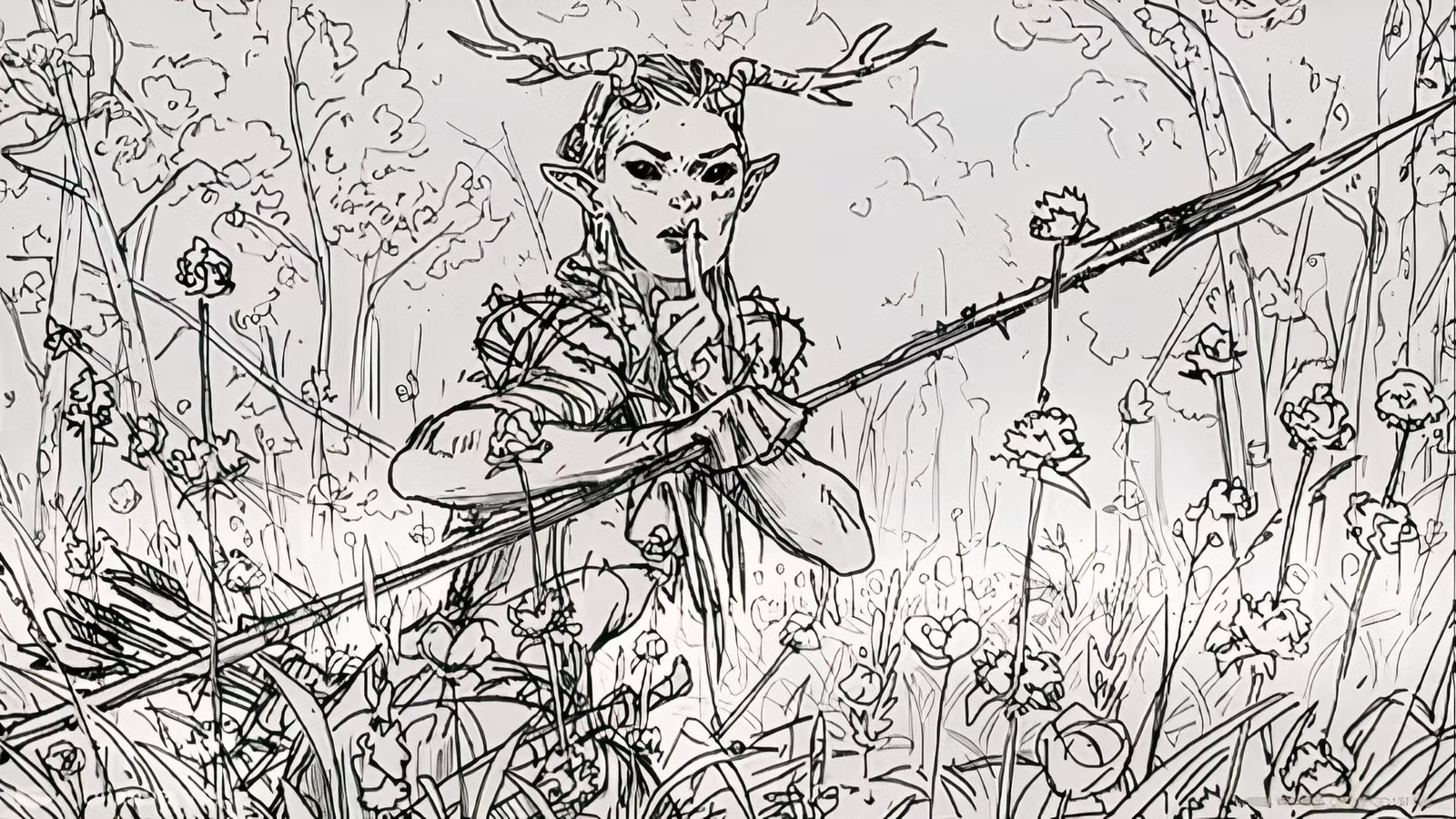
The initial release uses sketch-style versions of existing Magic artwork, giving what Rosewater described as a rough, “behind-the-scenes feel.”

“A lot of people like fantasy, and Magic also has a little more of a violent edge,” Rosewater said. “There’s a card called Murder and other things. I wanted to make something a little more universal that everybody can relate to.” His mother is a psychologist, and back in college, he wrote a play called Lego My Ego, where all the characters were emotions — hence the inspiration for a game where every single card represents a different emotion. Like the cards themselves, some of these emotions are more complex than others.
The result is something that feels less like a Magic spinoff and more of a profound question about tabletop gaming in general: What if things didn’t have to be so complicated?
Whether that idea catches on is still an open question. The first edition of Mood Swings will launch June 1 as a Secret Lair exclusive, priced at $24.99. Future expansions are possible, but Rosewater admitted it’ll depend on how well Mood Swings sells.
“I really, really believed in it,” he said. “I didn’t give up.”
About the Author