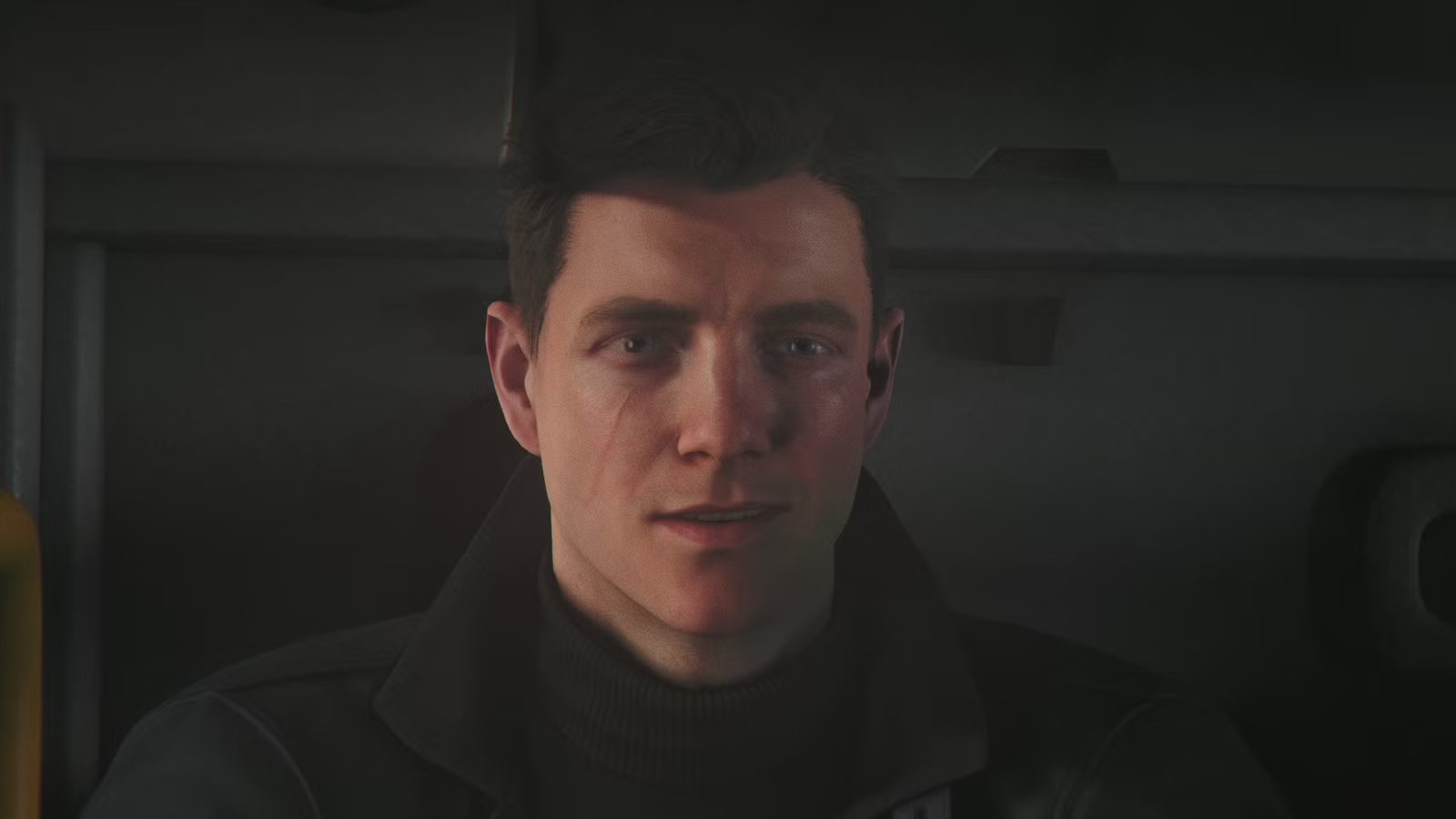
Playing three hours of Hitman developer IO Interactive’s new James Bond game 007 First Light, I was struck by how convincingly the game renders the world around the legendary spy. And yet, for me, 007 First Light struggles to summon the spirit of the character himself. The gameplay is a slick and engrossing mix of social spycraft, stealth, gadgets, and decisive action; the locations are handsome and plush. But the character, as played by Patrick Gibson, is almost unrecognizable.
To begin with, this is a young Bond. 007 First Light is an origin story that starts with the character as a Navy Airman and follows his induction into the secret service. The usually cynical and worldly character is quite chipper and even idealistic in this version. He chats away to himself and his handlers in a manner that even Bond’s smarmier movie incarnations — as played by Roger Moore, say, or Pierce Brosnan — would frown at. He is sincere and unpolished. To me, he seemed more Nathan Drake than James Bond, or perhaps like a sunnier version of Jack Lowden’s character in Slow Horses.
Within the confines of the preview, the character worked well as the protagonist of a shiny action game, but simply didn’t seem like James Bond. I was curious about the choices IO had made in interpreting this iconic hero, so I asked art director Rasmus Poulsen — a towering, broad, bearded Dane — about it. Poulsen knew exactly what I was talking about and could clearly articulate the studio’s reasoning; IO evidently thought deeply about the character and created its own version with intention.
“You say creating, I would say riffing on,” Poulsen said. The studio identified the core tenets of the character across its many different expressions, from the surly hero of Ian Fleming’s books, then through Sean Connery, Moore, Timothy Dalton, Daniel Craig, and others. “He’s a man of action that must see justice. He thinks on his feet and is rash, and he’s a charmer. He moves fast and breaks things.”
IO decided to tell an origin story to bring what can be a rather aloof character “closer to the gaming audience,” Poulsen said. “It gives us an arena to tell an interesting story and to play with lessons for Bond as a character, as well as lessons for the player in terms of mechanics and whatnot, as you and Bond together enter this world of espionage.”

This desire to make Bond a relatable avatar for the player was central to the way IO chose to write, cast, and design Bond. His talkative side is a result of IO’s wish to surface the analytical, observant workings of Bond’s mind, as expressed in Fleming’s books, in the more “external” medium of games. “What the books give you is a rich inner life, but it’s unexpressed externally,” Poulsen said. “How do we give you a sense of that? In games, we would have to express [it externally.] So yeah, he definitely narrates his intent and his sensibilities to you as you play the game, to welcome you into his world and his mindset.”
The same goes for Patrick Gibson’s casting and performance. “It’s been wonderful to see Patty take the role and really, really give it a fresh spin,” Poulsen said. The IO team wanted Gibson to help them break down the character’s iconographic exterior. “What can easily happen is that it becomes, let’s say… It is Bond, but nothing more. What Patty lends to it is a youthful, sort of a crisp earnestness to the role that makes him feel younger, but still impassioned. He feels like somebody who wants to do the right thing and he has that tenacity in him, but he doesn’t feel worn down.”
A problem with Bond, Poulsen explained, is that his immaculate cool, which is so enticing on a movie screen, can be alienating in the more intimate video game medium. “Patty has a willingness to take you along for the journey, which means the sense of cool you get from him is different from a sense of cool you will get from an older Bond. It was important to us to make him feel like you want to go on this adventure with him, rather than he’d rather not want you there.”

This was important in the arena of gameplay as well as performance. Poulsen said it was important for IO to get away from the amusing but distancing amorality of Hitman’s Agent 47, and tp make sure Bond acts with honor and only draws his weapon when drawn upon. “We have to make sure that Bond, the character you know and love, and you, the player, that there’s an overlap in your aspirations and how you would do things and why you would do things, to prevent narrative dissonance,” he said. “We need to have you and Bond being simpatico.”
All the same, the team at IO enjoyed flipping some expectations of the character. In one of the missions I played, Bond infiltrates a fancy gala, where in a break with form, he’s one of the only people not wearing a tuxedo. He’s dressed in a turtleneck and a leather jacket, collar popped.
“My favorite Bond is donning a suit and a rifle, and you’re like, OK, what happened there?” Poulson said. “I love that dichotomy because it is such a wonderful picture of the character and what you get from an adventure in a Bond fantasy. It says it all, it says culture, it says cultivated, it says there’s certain mannerisms, and yet you still find yourself in harm’s way with a rifle. And here we twist it on his head. […] He enters this cocktail party where he’s clearly the odd one out. So we invert how we deliver on this contrast of what you’re dressed like and where you find yourself, which is very, very Bondy, I think.”

In some ways, though, IO seems as if it’s trying to reduce every version of Bond — from the flamboyant world of You Only Live Twice, say, to the grittiness of Craig’s Casino Royale — into a middle-ground that is distinguishable as neither.
“The Roger Moore era was entertaining and fun, and some of the other outings have focused more on the darkness and the loneliness and the brokenness, I suppose, of a man who’s been in that line of work,” Poulsen said. “And I think it’s important to have both, because if you zoom out, both of these tenets are true for the character. So we try to balance these factors. We aren’t just giving you a singular reflection. We are giving you a composite of the values we feel like are true to craft a new Bond.”
This is fair enough, but perhaps it betrays a lack of confidence from IO — an unwillingness to put its own stamp on the character. If that’s the case, it’s not due to interference from the rights holders (now Amazon MGM). Poulsen said the Bond licensors were instantly supportive of big swings like the origin story choice, but smaller decisions could be much trickier. “Young Bond? Oh yeah, easy enough. What about the color of the car though? Yeah, that’s complicated,” he laughed. “Some of those have been really fun.”
Making James Bond relatable and young is, in one sense, a radical risk to take with the character. In another sense, though, it’s avoidance. If Bond is an everyman, if he’s whoever the player wants him to be, then IO doesn’t have to take its own definitive stance on a character that’s always hotly debated (especially here in the U.K.), that has historically problematic elements (as a sexist and as an avatar of British colonialism), and that means so many different things to so many different people.
As someone who’s grown up with Bond, I don’t know how I feel about it. But Poulsen seemed relaxed. “We all have preconceived notions of what Bond should be, which makes it incredibly fun for us to play with those expectations,” he said. “Everybody has an opinion about this guy and what he does and how he does it. That’s part of the fun!”
About the Author